
China Top Plastic Film Shredder Manufacturer Supplier?

Time:2026-09-21 Author:Amelia
0%

Choosing a China top Plastic Film Shredder manufacturer supplier requires more than comparing prices. Film waste varies widely, from thin agricultural sheets to printed packaging rolls and contaminated industrial liners. Each material demands a suitable cutting chamber, rotor design, screen size, and feeding method. A reliable supplier should explain these differences clearly.

Practical experience matters. Visit production facilities when possible, or request detailed factory videos, machine drawings, and trial-shredding records. Ask whether the equipment has processed film similar to yours. A strong manufacturer can provide measurable data, including throughput, motor power, noise levels, and final particle size. It should also explain how knives are replaced and how overload protection works.

Certifications help, but paperwork is not enough. Check manufacturing history, export experience, spare-parts availability, and customer references in comparable industries. Technical support should continue after delivery, including installation guidance and operator training. No supplier is perfect. Some brochures may present ideal performance under clean laboratory conditions. Real film can be wet, dusty, tangled, or mixed with labels. That difference deserves careful discussion. A trustworthy China supplier acknowledges limitations and recommends realistic testing before purchase. This approach supports safer operation, steadier production, and a more dependable long-term investment.
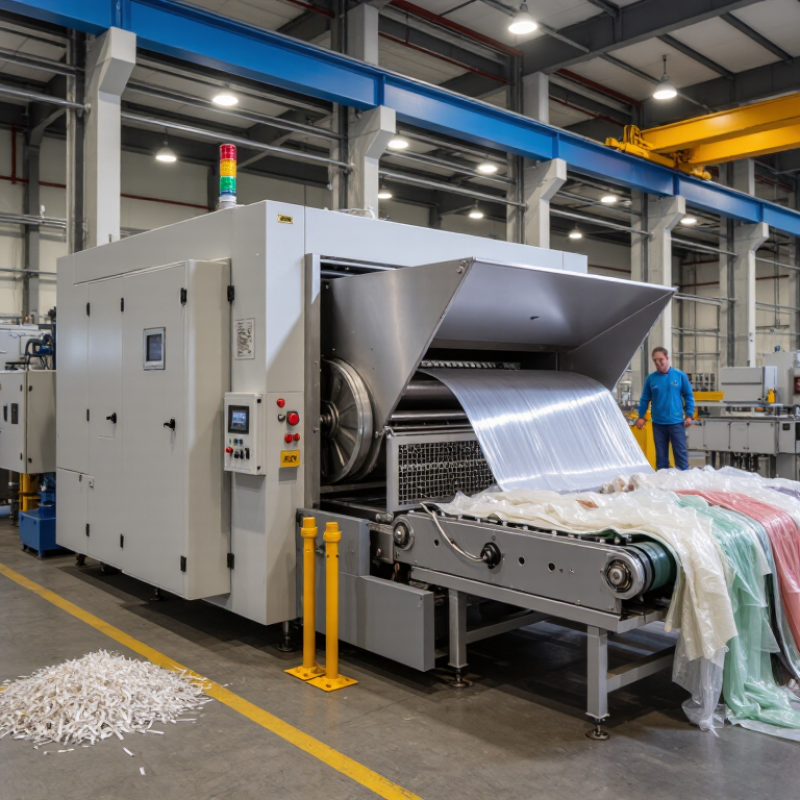
China Top Plastic Film Shredder Manufacturer Supplier?

What Is a Plastic Film Shredder?

What Is a Plastic Film Shredder?

A plastic film shredder is an industrial machine that cuts thin plastic waste into smaller, manageable pieces. It commonly processes shopping bags, agricultural film, stretch wrap, packaging film, and contaminated liners. Unlike a granulator, it usually uses slow-speed torque and sharp knives. This design helps reduce film wrapping around the rotor. It is not magic.

The machine prepares waste for washing, drying, pelletizing, or transport. A properly sized unit can improve feeding consistency and reduce storage volume. The OECD Global Plastics Outlook reported 353 million tonnes of plastic waste in 2019, while only 9% was recycled. This gap shows why efficient size reduction remains important. However, shredding alone does not create recycled material. Moisture, sand, labels, and metal parts can damage equipment and lower output quality. Real operating results depend on film thickness, feeding method, knife design, and maintenance. Some technical choices are still easy to underestimate.

Tips: Check the film’s moisture and contamination before selecting a shredder. Use a controlled feeder for loose, lightweight film. Inspect knives regularly, because blunt edges increase energy use and heat. The U.S. Environmental Protection Agency also identifies source separation as an important factor in improving plastic recovery. Start with a small material test. It may reveal problems that a brochure does not.

Key Features of China-Made Plastic Film Shredders

China-made plastic film shredders are designed for difficult, flexible feedstock. According to the OECD Global Plastics Outlook, the world generated 353 million tonnes of plastic waste in 2019, while only 9% was recycled. This pressure makes film preparation equipment increasingly important. Key features include low-speed, high-torque motors, reinforced shafts, and anti-wrapping knife designs. These systems can process agricultural film, packaging film, and production offcuts with fewer stoppages. Hydraulic pushers help maintain steady feeding when film forms soft, bulky bundles.

Control systems also matter. Many modern machines use PLC monitoring, overload protection, and automatic reverse functions. These features reduce operator intervention and protect cutting components. A practical machine should offer adjustable rotor speed and accessible knife maintenance. Dust covers and sealed bearings are valuable in dry workshops. However, not every advertised capacity matches real conditions. Wet film, sand, labels, and mixed thicknesses can reduce output sharply. This is where supplier testing becomes essential. Request a trial using your actual film, not a clean sample.

Tips: Check motor torque, chamber size, knife material, and power consumption together. Ask for measured throughput, noise data, and maintenance intervals. Leave room for imperfect feeding. A slightly larger chamber may prevent repeated bridging and manual clearing. Also verify electrical standards, spare-part availability, and operator training. A lower purchase price can become expensive when downtime increases.

China Top Plastic Film Shredder Manufacturer Supplier? - Key Features of China-Made Plastic Film Shredders

The specifications below represent common configuration ranges for industrial plastic film shredders made in China. Actual performance depends on film type, moisture, contamination, feeding method, screen size, and machine configuration.

Data Dimension Typical Specification or Range Technical Description Practical Buyer Consideration
Compatible Film Materials PE, LDPE, HDPE, PP, agricultural film, stretch film, woven bags, and packaging film Single-shaft and dual-shaft designs can process flexible plastic materials when the cutting system is correctly selected. Confirm whether the incoming material contains laminated layers, labels, metal parts, sand, or excessive moisture.
Typical Processing Capacity Approximately 100–2,000 kg/h Capacity varies substantially with film thickness, bulk density, feeding consistency, rotor design, and discharge particle size. Request a capacity test using the buyer’s actual film rather than relying only on an empty-machine rating.
Motor Power Approximately 15–160 kW for industrial applications Lower-power units are commonly used for light-duty recycling, while higher-power systems support heavier or continuous-duty processing. Check installed power, starting current, operating voltage, frequency, and whether a variable-frequency drive is included.
Rotor Speed Commonly about 40–100 rpm for low-speed shredding systems Low-speed, high-torque operation helps control flexible film and can reduce dust compared with high-speed impact equipment. Adjustable speed is useful when switching between thin film, woven sacks, and thicker plastic sheets.
Feed Opening Approximately 600–2,000 mm wide, depending on machine size A larger hopper allows bulky bales, bags, and loose film to be fed with less preliminary cutting. Match the opening to the bale dimensions and the available conveyor or loading equipment.
Output Particle Size Typically 20–100 mm, depending on cutter and screen configuration Shredders generally produce coarse, irregular pieces; granulators or pelletizing lines may be required for finer size reduction. Select the target size according to washing, conveying, densifying, or extrusion requirements.
Cutting System Replaceable rotary knives with fixed counter-knives Knife geometry, clearance, material hardness, and number of cutters affect cutting quality and energy consumption. Ask for knife material, heat-treatment details, adjustment method, and the cost of replacement sets.
Knife Material Commonly alloy tool steel or hardened high-strength steel Wear-resistant knife materials are important when processing contaminated post-consumer or agricultural film. Verify hardness, replaceability, sharpening options, and availability of spare knives.
Drive and Torque Protection Electric motor with gearbox; overload protection commonly included Torque-limiting or reverse-control functions help protect the rotor when foreign objects or excessive loads cause blockage. Check whether automatic reversing, emergency stop circuits, and overload alarms are standard or optional.
Moisture Handling Suitable for dry film; wet-film capability depends on the machine and downstream system Water, oil, and residual product can affect feeding, throughput, corrosion, and discharge performance. Provide the expected moisture range and contamination level before selecting seals, bearings, and discharge equipment.
Typical Machine Construction Welded steel frame with reinforced cutting chamber Heavy structural construction helps reduce vibration and supports continuous industrial operation. Review frame thickness, access doors, weld quality, bearing protection, and maintenance access.
Control System Electrical control cabinet with start/stop, overload, emergency stop, and reversing functions More advanced systems may include programmable controls, automatic feeding, current monitoring, and interlocks. Confirm control-panel language, electrical components, safety circuit design, and compatibility with the local power supply.
Noise and Dust Management Noise and dust levels depend on speed, material, enclosure, and feeding system Film shredding can generate airborne dust and noise, especially when contaminated material is processed. Consider acoustic panels, sealed hoppers, dust extraction, ventilation, and workplace noise requirements.
Safety Features Emergency-stop button, safety interlocks, overload protection, and guarded moving parts Industrial shredders require safeguards around the hopper, rotor, discharge area, and maintenance access points. Request safety documentation, wiring diagrams, risk-control details, and conformity information for the destination market.
Maintenance Requirements Regular knife inspection, clearance adjustment, bearing checks, lubrication, and chamber cleaning Flexible film can wrap around the rotor if feeding conditions and knife settings are unsuitable. Evaluate cleaning access, lockout procedures, service intervals, and the availability of local technical support.
Downstream Compatibility Can be integrated with conveyors, metal separators, washing lines, dryers, compactors, or granulators Shredding is often the first size-reduction stage in a plastic recycling process. Confirm discharge height, conveyor speed, material flow, and required integration signals before ordering.
Quality Verification Factory testing, load testing, dimensional inspection, and electrical testing are recommended Performance should be evaluated using representative feedstock and the intended operating conditions. Include agreed capacity, particle size, power consumption, spare parts, and acceptance criteria in the purchase contract.
Best-Fit Applications Recycling plants, film washing lines, packaging-waste recovery, agricultural-film recycling, and plastic reprocessing Shredders are most effective when the material preparation and downstream equipment are properly matched. Choose the machine based on the complete recycling workflow rather than throughput alone.

How Plastic Film Shredders Are Manufactured

A plastic film shredder begins with a clear study of the material.

Engineers examine film thickness, moisture, contamination, and daily processing volume. In a Chinese factory, this information guides the machine’s structure and power requirements. The frame is usually cut from thick steel plates. Welders join each section carefully, then remove sharp edges and surface defects. It is not glamorous work, but small errors can create vibration later.

The cutting chamber receives special attention.

Technicians install a rotor, fixed knives, bearings, and an adjustable screen. Knife gaps must remain consistent for stable shredding. A strong motor provides torque, while overload protection helps reduce mechanical stress. Before shipment, workers test noise, temperature, feeding performance, and emergency stopping. Some results may need adjustment. Manufacturing is controlled, yet no machine is perfect on its first test.

Tips:

Ask for a trial using your actual film. Check the knife material, screen size, motor rating, and cleaning access. Inspect welds and safety guards closely. A compact design may save space, but it can make maintenance harder. Keep records of test settings; operators often overlook this practical detail.

How to Evaluate a Chinese Shredder Supplier

China Top Plastic Film Shredder Manufacturer Supplier?

How to Evaluate a Chinese Shredder Supplier

Choosing a Chinese plastic film shredder supplier requires more than comparing quotations. Start by checking the factory’s production experience, engineering team, and actual workshop capacity. Request videos of film feeding, knife adjustment, discharge, and cleaning. Better still, arrange a live test using your own film, including thin bags, printed rolls, and damp material. A machine that performs well on clean samples may struggle with tangled film. Ask for measurable results, such as throughput, motor power, particle size, and energy use. Every number should match a test condition.

Inspect the shredder’s construction closely. Check the rotor diameter, knife material, bearing protection, electrical cabinet, and access doors. Request drawings, spare-parts lists, maintenance instructions, and a clear warranty scope. The supplier should explain delivery checks and remote troubleshooting without vague promises. Visit the factory if possible, and compare its claimed capacity with machines already operating at customer sites. A polished video is not proof. I have seen evaluations focus too heavily on price, while ignoring downtime caused by poor film feeding. That mistake becomes expensive. Ask how the supplier handles design changes, replacement parts, and operator training. Do not accept every answer immediately; some technical details still need independent verification.

Applications, Maintenance, and Service Considerations

China Top Plastic Film Shredder Manufacturer Supplier?

Applications, Maintenance, and Service Considerations

Plastic film shredders support recycling lines, packaging plants, agricultural recovery, and post-industrial scrap handling. Flexible film behaves differently from rigid plastic. It wraps around shafts, traps heat, and changes feed pressure. Application testing matters more than brochure capacity.

PlasticsEurope reported global plastics production at 400.3 million tonnes in 2022. The OECD estimated that only 9% of plastic waste was recycled globally in 2019.

These figures underline the need for reliable size reduction. A China-based supplier should test your actual film, moisture level, and contamination profile. Ask for throughput in kilograms per hour, not vague claims.

Maintenance directly affects uptime. Inspect blades, screens, bearings, and anti-wrap devices on a fixed schedule. Film dust can hide early wear. Clean the chamber after each shift when adhesive residues are present. Record motor load, vibration, knife clearance, and rejected output.

Service quality also matters. Request spare-parts availability, remote diagnostics, operator training, electrical compatibility, and clear warranty limits. A low purchase price can become expensive when one custom blade stops production. Do not assume every machine handles laminated or wet film equally. That assumption is often wrong.

Tips: Run a 30-minute acceptance test. Measure output, amperage, noise, and temperature. Keep two knife sets when downtime is costly. Review performance after three months. I would question any supplier avoiding application data. It sounds cautious, but real film waste is rarely perfectly clean.

FAQS

What is a plastic film shredder?

It is an industrial machine that cuts thin plastic waste into smaller pieces. It often handles bags, stretch wrap, agricultural film, and packaging film. It is not magic.

How does a film shredder differ from a granulator?

A shredder usually uses slow speed, high torque, and sharp knives. This design helps reduce plastic wrapping around the rotor. A granulator normally produces smaller, more uniform particles.

What happens after plastic film is shredded?

Shredded film may move to washing, drying, pelletizing, or transport. Size reduction can improve feeding consistency. It can also reduce storage space.

Which materials can reduce shredding performance?

Wet film, sand, labels, and mixed thicknesses may lower output. Metal pieces can damage knives and shafts. A dirty feedstock needs realistic testing.

Why is controlled feeding important?

Loose film is lightweight and easily bridges inside the chamber. A controlled feeder helps maintain steady material flow. Manual clearing is slow and unpleasant.

Which machine features deserve close attention?

Check motor torque, chamber size, shaft strength, and knife material together. Anti-wrapping knives can reduce stoppages. Hydraulic pushers may help with bulky film bundles.

How can operators reduce maintenance problems?

Inspect knives regularly and replace or sharpen blunt edges. Blunt knives increase energy use and heat. Sealed bearings and protective covers may help in dusty workshops.

How should a buyer verify advertised capacity?

Request a trial with actual film from the intended process. Clean samples can give misleading results. Measure throughput with moisture, sand, labels, and mixed thicknesses included.

What details should be checked before purchase?

Confirm electrical standards, spare-part access, operator training, noise levels, and maintenance intervals. Leave space for imperfect feeding. A cheaper machine may cost more during frequent downtime.

Conclusion

A Plastic Film Shredder is designed to reduce used plastic films, bags, agricultural films, packaging materials, and similar flexible plastics into smaller, more manageable pieces for recycling or further processing. China-made plastic film shredders commonly feature low-speed, high-torque operation, durable cutting systems, adjustable feeding structures, safety protection, and energy-efficient motors. Their manufacturing process typically includes material selection, precision machining, component assembly, electrical installation, and performance testing to ensure stable operation and reliable output.

When evaluating a Chinese shredder supplier, buyers should consider manufacturing experience, equipment quality, customization capabilities, production capacity, inspection procedures, and after-sales support. It is also important to match the machine’s capacity and feeding design with the intended application and material type. Regular maintenance, including blade inspection, cleaning, lubrication, and checking electrical components, helps extend service life and maintain performance. Clear installation guidance, spare-parts availability, operator training, and responsive technical service are equally valuable when selecting a long-term supplier.

Amelia

Amelia

Amelia is a seasoned marketing professional with a wealth of expertise in our company’s core offerings. With an unwavering passion for driving growth and innovation, she plays a pivotal role in shaping our marketing strategies and enhancing brand visibility. A key aspect of her responsibilities......